
Copyright Ownership, Infringement, and AI Training
Key Insights from the Copyright Society’s 2025 Dublin Meeting

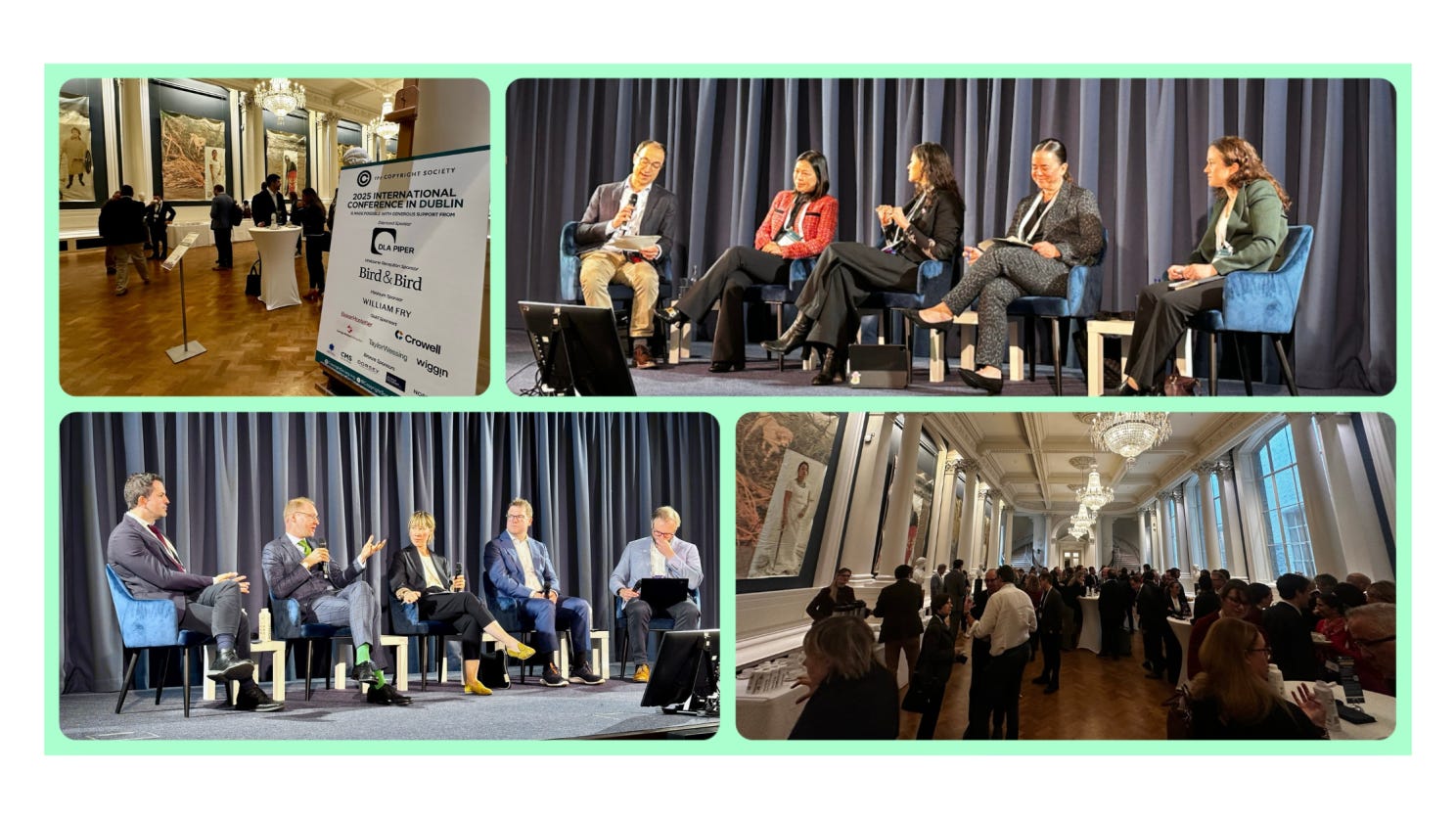
A few weeks ago, from October 19–22, the Copyright Society held its International Conference in Dublin, Ireland, bringing together leading voices from private practice, collective management organizations, industry, and policy to examine how copyright law is responding to the rapid deployment of generative AI across jurisdictions.
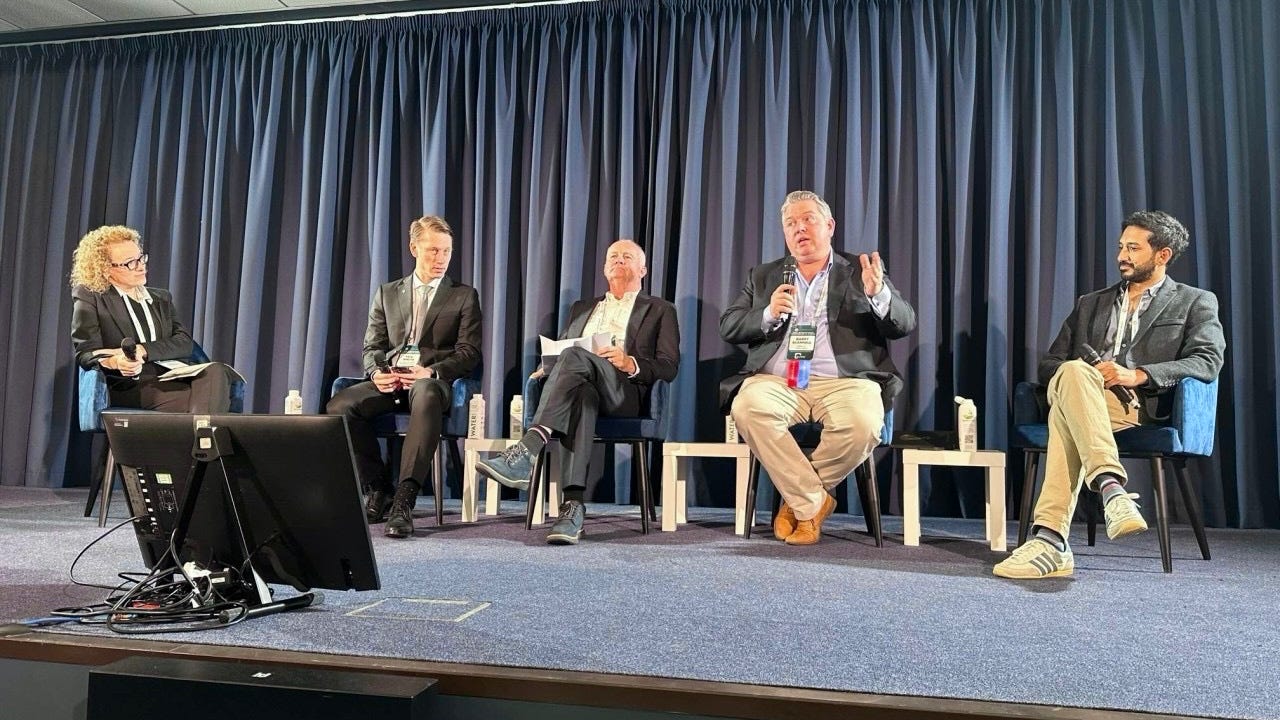
This post summarizes the key takeaways from the panel “Copyright and AI: Ownership, Infringement, and Extraterritoriality,” where I had the privilege of sharing ideas alongside esteemed global experts in IP, including Sarah Wright, Dr. Barry Scannell, Abbas Lightwalla and Victor Finn. We explored perspectives from different continents and stakeholder groups, and discussed how copyright law may need to adapt to provide greater certainty and clarity as AI technologies continue to evolve.
The Central Tension: Copyright Law at an Inflection Point
The panel opened with a deceptively simple question: How should copyright law treat works created using AI—and how do the positions differ between the EU and the United States?
Barry Scannell explained that the answer differs sharply across jurisdictions. In the United States, the position has been extremely definitive: “unless it was created by a human, it can’t be protected by copyright.”
The U.S. Copyright Office has doubled down on this view, most notably in the Zarya of the Dawn decision, where AI-generated images were excluded from copyright protection and only the human-authored selection and arrangement of those images received protection. Following that decision, the U.S. Copyright Office issued further guidance clarifying its approach. The key unresolved issue remains how much human input is required. Barry noted that determinations of human input and copyrightability are made on a case-by-case basis.
In Europe, the picture is more fragmented. Continental European systems emphasize droits d’auteur and authorial personality—treating a work as an expression of the human mind. Notably, there is no EU-wide definition of authorship.
Ireland and the UK remain outliers due to their legacy provisions on “computer-generated works,” originally drafted in the late 1980s, long before generative AI was imaginable. As Barry put it rather bluntly:
“When that (Irish) provision was written in 1988, they were not writing with AI in mind. They were talking about graphics on a Commodore 64.” - Barry Scannell
Against this backdrop, Barry explained that the current Irish legislation has come under increasing criticism and is widely viewed as requiring revision. He concluded his overview by observing that there is no clear answer at the EU level (je ne sais pas!). What is clear, however, is a historical mismatch that is both striking and instructive: we are attempting to solve 21st-century problems with 20th-century legal abstractions.
Is Global Consensus on Copyrightability of AI-assisted Outputs Possible?
Abbas Lightwalla shared his view that most jurisdictions are likely to converge on a core principle of copyright law: protection requires originality rooted in human intellectual creation. In the UK, as in other common-law jurisdictions that inherited the 1988 framework, mere words or mechanically generated outputs are insufficient to warrant copyright protection.
While the UK was among the first countries to contemplate computer-generated works, Abbas emphasized that there is no policy justification for extending this provision to generative AI, particularly where AI systems can produce thousands of works at scale. In his view, copyright law should not be used to incentivize autonomous models that require no creative encouragement.
Sarah Wright concluded this discussion by highlighting the risk that setting the originality threshold too low for AI-generated or lightly AI-assisted works could lead to overly broad copyright protection, potentially distorting the creative ecosystem. She cautioned that such an approach might crowd out human creativity by granting protection to large volumes of minimally modified AI outputs.
The Need for More Transparency in AI Training
Victor Finn emphasized that if copyrighted works are used as inputs by AI platforms, the resulting outputs should remain within the scope of copyright protection, even if this leads to a dramatic increase in the number of protected works.
He noted that the creative industries—particularly music—have already experienced exponential growth in the number of works over the past two decades due to technological advances, and that collective management organizations have successfully adapted to this expanded landscape.
He argued that the market ultimately determines which works achieve commercial significance, and that copyright law should continue to support orderly licensing and fair remuneration rather than restrict protection out of fear of volume. From his perspective, the core problem is not the proliferation of AI-assisted works, but the lack of transparency around what copyrighted materials are being used in AI training, which makes licensing impossible and deprives creators of compensation—an issue the EU AI Act is specifically designed to address.
“We are there to ensure that creators at the end of the chain get a fair remuneration—but at the moment, it is very difficult to conclude licenses because we simply do not know what works are being used.” - Victor Finn
AI Training and Justification for a Broad TDM Exception
Sarah Wright framed AI training as one of the most contested and fast-moving issues in contemporary copyright law, noting the sharp contrast between the US where multiple cases are already unfolding and Europe, where judicial guidance remains limited.
She highlighted the UK’s current uncertainty following the IP Office’s public consultation, which attracted more than 11,000 responses and led to the creation of several working groups, yet left both the substance and the timeline of reform unresolved.
(As an update, the UK has since published an initial report indicating that 88% of respondents supported Option 1: requiring licences in all cases.)
By contrast, Sarah explained that the EU has already moved ahead with a more structured framework, including a general text-and-data-mining (TDM) exception that allows commercial AI training unless rights holders opt out. This regime is coupled with new transparency obligations for developers of general-purpose AI models, such as publishing summaries of training data and compliance policies.
Against this regulatory backdrop, Sarah invited a technology-driven perspective on whether the UK should align itself more closely with the EU approach. She framed the question not only as a matter of copyright doctrine, but as a strategic policy choice about innovation, legal certainty, and the UK’s future position in the global AI ecosystem. She asked me to share some arguments in favor of a broad exception, particularly for the UK.
I framed my intervention around three interrelated arguments, all grounded in how AI development actually functions today. Speaking from a Silicon Valley perspective, I suggested that the debate over AI training has already moved beyond first principles and into a very practical phase focused on deployment, implementation, and real-world applications. In that context, the legal framework governing training data is no longer an abstract copyright question but a core issue of a broader innovation policy.
To kick-off the discussion, I shared a quote from the recent event where the US Government introduced US AI Action Plan:
“You can’t be expected to have a successful AI program when every single article, book or anything else that you’ve read or studied, you’re supposed to pay for,” he said. “You just can’t do it because it’s not doable. ... China’s not doing it.”- US President Donald Trump
First, I argued that innovation policy is copyright policy. A broadTDM exception would send a powerful strategic signal that the UK is open to experimentation, research, and startup formation. In a global environment where the EU, Japan, and Singapore already offer some form of legal clarity, regulatory ambiguity risks becoming a competitive disadvantage rather than a safeguard.
Second, I emphasized the small-player reality of AI development. Much of today’s AI innovation comes not from trillion-dollar platforms but from startups, universities, and research teams that simply lack the resources to negotiate hundreds or thousands of individual licences. In such cases, the absence of a clear exception does not lead to better remuneration; instead, it produces market failure by preventing legitimate entry altogether.
Finally, I stressed that clarity is better than uncertainty. From a law-and-economics perspective, unclear rules benefit no one: rights holders cannot enforce effectively, developers cannot plan responsibly, and courts are left to act as de facto regulators. The core challenge is not whether copyright should be weakened, but how to design a modern framework that provides predictable, workable rules. The sooner such clarity is achieved, the better the outcome for innovation and rights protection alike.
Transparency, Not Exceptions
The pushback from the music industry side was principled and forceful—and, in many respects, persuasive. Victor Finn (IMRO) captured the core concern succinctly: “At the moment, we simply don’t know what works are being used, and that makes licensing impossible.”
Both Victor and Abbas emphasized that the EU AI Act’s transparency obligations to provide summaries of training data, compliance policies, and disclosure mechanisms are more important than new exceptions. Abbas went further, challenging the idea that AI needs free access to copyrighted works at all:
“We don’t need the works of the Rolling Stones to develop AI that helps with genome editing.” - Abbas Lightwalla
All panelists shared the view that not all AI use cases are equal, and copyright law must eventually distinguish between them. One of the most nuanced parts of the discussion concerned the difference between training (input) and generation (output).
From the Silicon Valley side, there is a strong narrative that infringement should be judged primarily at the output stage—whether the AI generates something substantially similar to an existing work. From the rights-holder side, this framing is seen as deeply misleading.
“Reproductions do happen when training a model, and that’s where so much of the commercial value comes from.” - Barry Scannell
The EU AI Act has already taken a position here, treating training itself as a legally relevant act requiring authorization unless an exception applies.
My own contribution tried to add some nuance to the picture by pointing out that advanced AI users (especially creative artists who are actually able to sell their work in the market) are not passive prompt-typers. They iterate, curate, combine multiple tools, and inject their own materials into the process. The future debate will not be about “AI-generated vs human-generated,” but about degrees of human control, authorship, and intentionality.
(Extra)Territoriality: The Quiet Battlefield
Another theme that resonated strongly was about jurisdiction and the territorial nature of IP rights. Abbas noted that over 50 of the 70+ AI copyright cases globally are currently pending before the United States courts. This is so not because the issues are uniquely American, but because training and server infrastructure are concentrated there.
Since the conference took place in Dublin, it was interesting to hear the opinion that Ireland, interestingly, may emerge as a key litigation venue due to its role as Europe’s server hub, because most of Europe’s internet lives in Ireland on Irish servers.
The EU AI Act’s extraterritorial reach requiring compliance with EU copyright-related obligations if a model is placed on the EU market was defended as standard product liability regulation, not a violation of international copyright law. The analogy offered by one of the speakers was about baby food: “If you want to sell baby formula in Europe, you comply with European standards. AI is no different.”
Paths Forward: Licensing Will Happen, But Differently
One of the most constructive moments came toward the end of the panel, when the conversation shifted away from litigation and toward market design.
Despite some diverse opinions, there was broad consensus on one point: licensing markets will emerge. In fact, they already are. AI developers are beginning to market themselves on EU AI Act compliance, transparency, and clean training data. New models are being trained on licensed or curated datasets.
The future is not “free use vs total prohibition.” It is new technical and legal architectures that allow: AI development, rights-holder control, scalable remuneration and thus leading to greater legal certainty.
Copyright has reinvented itself before—photography, radio, sampling, the internet. AI is simply the next stress test. If we get this right, copyright will remain what it was always meant to be: an engine of innovation and creativity.